I’ve been making vision boards for years. Not because it’s trendy. Not because social media told me to. But because every time I get clear on what I want and give it somewhere to live outside of my head, something starts to shift.
Vision boards have been around for years, yet every time they resurface, the reactions are the same. Some people swear by them. Others dismiss them as wishful thinking. But vision boards were never meant to be magical shortcuts —they’re meant to be direction setters.
They force you to look at your desires instead of avoiding them. And once something is clearly seen, it becomes harder to unconsciously move against it.
The Bible puts it plainly: “Where there is no vision, the people perish.” Not because life stops, but because without vision, we drift. We move through life on autopilot.
Interestingly, this idea isn’t just spiritual, it shows up again and again in self‑help and neuroscience literature. Dr. Joe Dispenza often talks about how the brain needs a clear mental image of the future to move the body toward it, explaining that without intention and vision, we keep recreating the same past on repeat. Joseph Murphy wrote extensively about how what we consistently impress upon the subconscious mind becomes our lived experience. Even Neville Goddard emphasized that imagination, when paired with belief, is the starting point of all creation.
Different language, same truth: without vision, nothing new can take shape.
A vision board is a visual declaration. A quiet but firm: this is where I’m headed.
Why Vision Boards Are Linked to Manifestation
People believe vision boards help with manifestation because they combine intention, repetition, and belief.
When you see something consistently, your mind stops labeling it as unrealistic. Your nervous system begins to treat it as familiar. And what feels familiar no longer feels threatening.
This matters, because many of the things we desire — love, freedom, abundance, expansion — also trigger fear on a subconscious level. Vision boards gently recondition that response. They don’t force belief. They sustain it.
Spiritually, this aligns with faith. Yet faith isn’t about immediate proof; it’s about holding a vision even when your current reality hasn’t caught up yet. A vision board is faith made visible.
When the Vision Becomes Real
Over the years, I’ve made many vision boards. Digital ones. Physical ones. And I’ve watched more than a few things quietly move from board to real life.
One of the biggest examples for me was my recent trip to Brazil. Brazil had been on my physical as well as digital vision boards. I didn’t obsess over how it would happen or when. I just allowed it to exist as something meant for me. And then I found myself wandering the streets of Sao Paulo.

That’s often how manifestation looks in practice. Not forced. Not rushed. Contrary to popular beliefs: vision boards work because they change you first. God and the universe slowly rearrange itself to meet the version of you who already made room for it internally.
3 Ways to Create Your Own Vision Board
One thing is very important to keep in mind: there isn’t one right way to make a vision board. What matters is that it feels aligned, intentional, and personal for you. Below are three methods that I have used.
A Digital Vision Board in Canva
If you’re on your phone or laptop a lot, this can be one of the most effective methods.

Using Canva, you can design a collage with images, affirmations, and quotes. Choose visuals that represent how you want to feel, and all you you want to have. Once finished, save it as your phone or laptop background.
This turns your vision board into a daily anchor. You see it when you text, when you unlock your device, when you are writing your email. Over time, it subtly trains your focus toward where you’re going instead of where you’re stuck. And you know what they say: energy flows, where attention goes.
A Vision Board on Pinterest
Create a private board and start pinning anything that resonates: places, colors, interiors, outfits, words, experiences. Don’t overthink it. Don’t justify it. Let your intuition lead.
After a while, you’ll start noticing recurring themes: freedom, softness, stability, creativity, depth. Pinterest becomes less about collecting images and more about reflecting your inner world back to you.
This method is ideal during transition seasons or when you’re redefining what you actually want.
A Physical Vision Board
This will always be my favorite as it includes your personal energy.
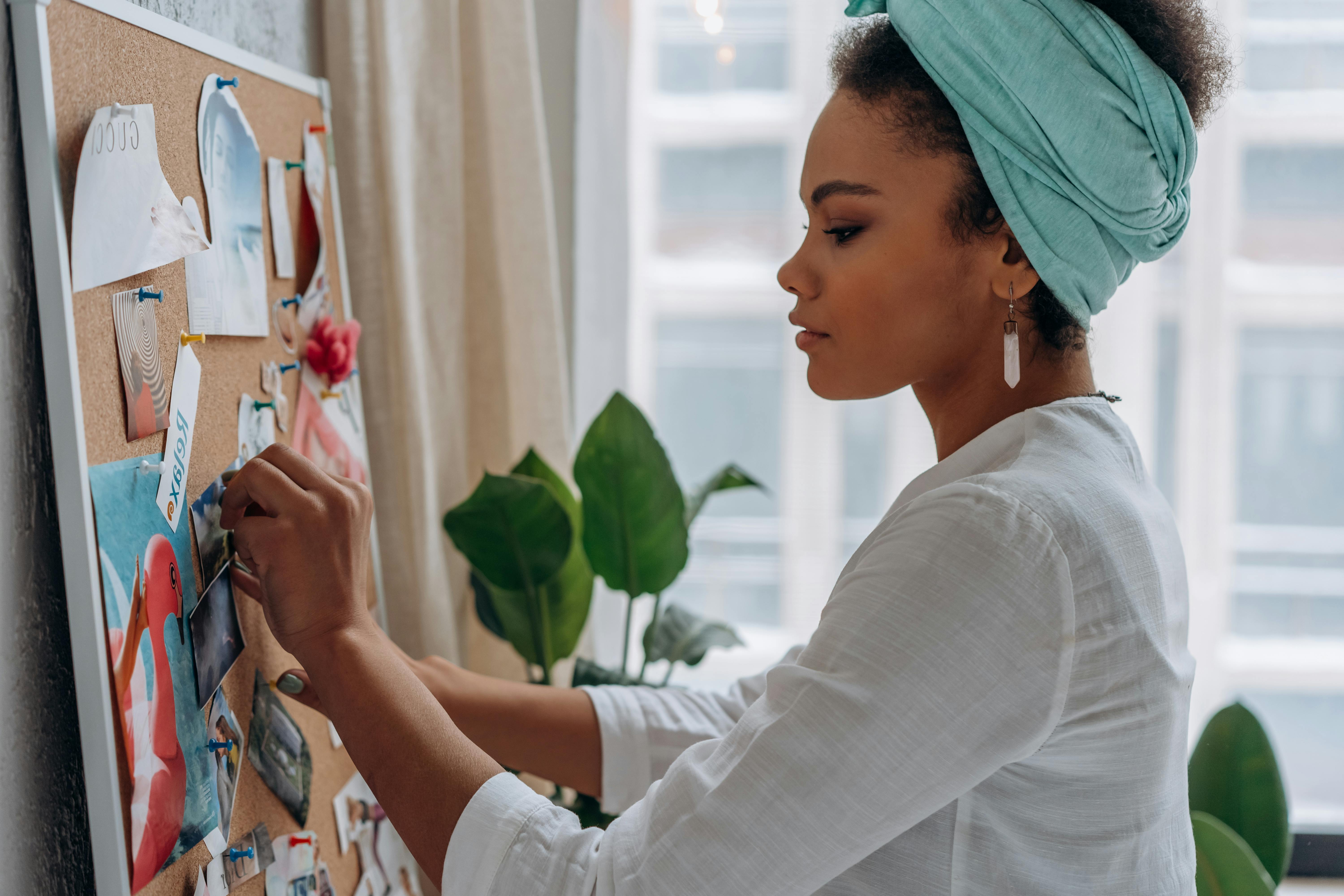
A physical vision board asks you to slow down. To cut, write, arrange, and choose with intention. It’s tactile, embodied, and deeply personal.
When you create a physical board, you’re putting your personal energy into it: your focus, your presence, your prayers.
I like to make mine at home by setting a vibe: turn up some music, grab a glass of wine and light up some palo santo. Then just allow my energy to cut and paste all that aligns with my vision.
This kind of vision board doesn’t live on a screen. It lives in your space with your personal energy.
Vision Boards Don’t Replace Action; They Direct It
Let’s get one thing straight: vision boards don’t do the work for you. They guide you into taking aligned action. Faith without works is just wishing, but works without vision is exhausting.
A vision board reminds you what to say yes or no to. It helps you to stay focused and determined. It reminds you why you’re not quitting, even when it would be easier.
Again, it’s not about forcing reality. It’s about alignment. Becoming congruent with what you’re praying for.
So if you’ve been feeling disconnected or uninspired, maybe it’s not discipline you’re lacking. Maybe it’s vision.
And once you see clearly again, moving forward becomes a lot less confusing.



Leave a Reply